
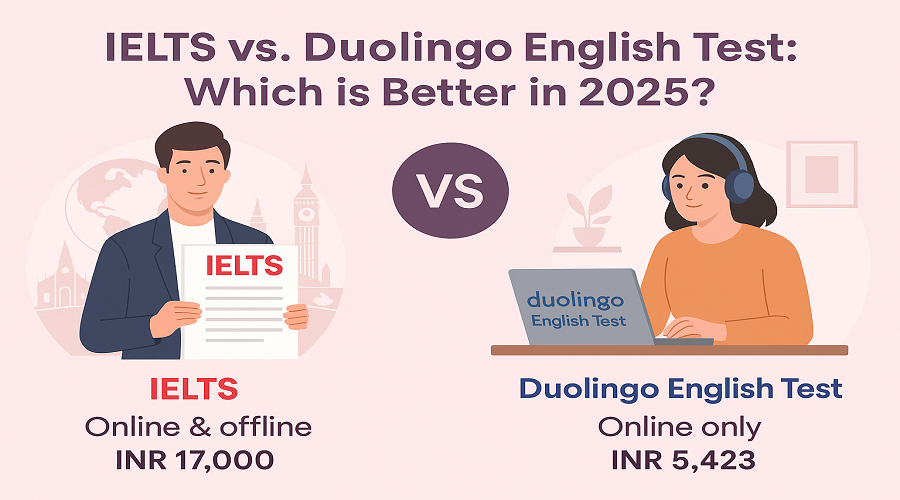
The IELTS (International English Language Testing System) and the Duolingo English Test (DET) are the most prevalent tests to demonstrate English proficiency when pursuing international universities or visas. However, which is the better option for you in 2025? This blog will compare the two tests based on acceptance, format, cost, convenience, and which is better for universities and visas.
What is IELTS?
The IELTS is an established and globally recognized test of English competence. The British Council, IDP: IELTS Australia, and Cambridge Assessment English work together to oversee it. Candidates are evaluated on four skills: speaking, writing, listening, and reading.
What is DET (Duolingo English Test)?
A more recent digital-first language test that has grown in popularity because it is convenient and reasonably priced is the Duolingo English Test. It uses adaptive testing to assess candidates' hearing, reading, writing, and speaking skills in English.
Which test modes are available for Duolingo and IELTS?
- IELTS: Provides test-takers with flexibility by being available in both online and offline (pen and paper) forms.
- Duolingo Test: Students can take it from any location with dependable internet connectivity because the test is only available online.
What are the costs of the Duolingo and IELTS tests?
Exam fees are one of the key ways that these assessments differ from one another. This is a breakdown of costs:
- IELTS Academic & GT (General Training Test): INR 17,000 for pen-and-paper and computer-based versions.
- Duolingo: INR 5,423 (USD 65).
Which colleges accept scores from Duolingo and IELTS?
Acceptance of the IELTS –
- Acknowledged by more than 11,000 organizations worldwide.
- Accepted in major English-speaking nations, including Canada, Australia, New Zealand, Ireland, the United States, and the United Kingdom.
- Numerous prestigious universities, such as Ivy League schools and European establishments, need it.
Duolingo acceptance-
- Duolingo's acceptance is growing, as more than 4,500 universities already accept it.
- While many US and Canadian institutions embrace it, several esteemed universities still favour the IELTS.
- While some colleges need IELTS or TOEFL for graduate applications, they accept DET for undergraduate programs.
Which Test is Better for Visa Applications?
IELTS for Visa Applications-
- Highly recommended for student visas, work visas, and immigration processes.
- IELTS Academic is widely accepted for university admissions, while IELTS General Training is used for work and immigration.
- Required for visa applications to Canada, the UK, Australia, and New Zealand.
Duolingo for Visa Applications-
- Not officially accepted for visa applications in most countries.
- Some universities accept it for admissions, but you may still need IELTS for your visa.
- UK, Australia, and Canada do not accept Duolingo for visa purposes.
What are the exam patterns and formats of the IELTS and Duolingo Tests?
The two tests have somewhat different formats.
IELTS-
- Listening: 40 questions covering social and educational contexts in 30 minutes.
- Reading: 40 questions based on various sources, including books, periodicals, and journals, in 60 minutes.
- Writing: Two assignments of 150 and 250 words each must be completed in 60 minutes.
- Speaking: A three-part, in-person interview that lasts 11–14 minutes.
The Duolingo Test –
- Onboarding and introduction: Setup and ID verification takes about five minutes.
- Adaptive test: This 45-minute test modifies its difficulty level in response to the test-taker's answers. It addresses speaking, writing, listening, and reading.
- Video interview: consists of a written response lasting three to five minutes and a spoken response lasting one to three minutes. The exam offered by Duolingo is more convenient for test-takers because it is significantly shorter, entirely online, and employs adaptive assessment.
|
Aspect |
IELTS |
Duolingo |
|
Sections |
Listening, Reading, Writing, Speaking |
Adaptive test covering Reading, Writing, Listening, Speaking |
|
Listening |
This section involves listening to recordings of native English speakers and answering questions. There are 4 sections, each increasing in difficulty. |
Listening skills are tested throughout the adaptive test with various question types, such as identifying spoken words or phrases. |
|
Reading |
Includes three long texts that range from descriptive and factual to discursive and analytical. Questions include multiple-choice, matching, and short-answer questions. |
Reading comprehension is assessed through the adaptive test, which consists of tasks like reading and understanding short and long texts, identifying missing words, and interpreting meaning. |
|
Writing |
Consists of two tasks. Task 1 requires writing a short essay based on a graph, table, chart, or diagram. Task 2 requires writing a formal essay in response to a point of view, argument, or problem. |
Writing is integrated into the test with tasks that may include writing brief responses to prompts, completing sentences, and writing a short essay. |
|
Speaking |
Conducted as a separate part of the test, either face-to-face or via video call with a trained examiner. It involves a structured interview, a short speech, and a discussion. |
Speaking tasks are included in the adaptive test, which has a video interview format. Test-takers respond to prompts by speaking into the computer's microphone. |
What is the curriculum or syllabus for the Duolingo and IELTS tests?
Speaking, writing, listening, and reading are the four fundamental language skills tested on both tests; however, the methods used to evaluate these abilities vary.
- Listening: Duolingo encourages test-takers to recognize the correct spoken words and transcribe audio recordings, whereas IELTS requires them to complete assignments based on recorded conversations or monologues.
- Writing: In an essay, IELTS test takers summarize visual data and address a point of view. On the other hand, the Duolingo practice test requires students to write a 500-word essay and fill in the blanks.
- Reading: Duolingo assessments concentrate on completing logical sentences and filling in missing words, whereas IELTS incorporates lengthy passages from novels and magazines.
- Speaking: Duolingo needs spoken responses recorded on the test site, whereas IELTS uses an in-person interview.
What is the difference between IELTS and Duolingo?
Key differences between IELTS and Duolingo
- Recognition & Acceptance
- IELTS: Accepted by over 11,000 institutions worldwide, including universities and governments, for visas.
- Duolingo: Accepted by 4,500+ institutions, mainly for university admissions, but not for visas in most countries.
- Test Format
- IELTS: Four sections – Listening, Reading, Writing, and Speaking.
- Duolingo: Adaptive test covering all skills in a single section.
- Test Duration
- IELTS: 2 hours 45 minutes.
- Duolingo: 45–60 minutes.
- Test Mode
- IELTS: Conducted at test centres (paper-based or computer-based).
- Duolingo: Online-only from home.
- Speaking Section
- IELTS: Conducted face-to-face or via video call with a human examiner.
- Duolingo: AI-based recorded responses.
- Scoring System
- IELTS: 0-9 band scale.
- Duolingo: 10-160 scale.
- Cost
- IELTS: $200–$250 (varies by country).
- Duolingo: $59.
- Result Availability
- IELTS: 3–13 days.
- Duolingo: Within 48 hours.
- Visa Acceptance
- IELTS: Required for student/work visas in countries like the UK, Canada, Australia, and New Zealand.
- Duolingo: Not accepted for visa applications.
|
Feature |
IELTS |
Duolingo English Test (DET) |
|
Acceptance |
11,000+ institutions & visas |
4,500+ institutions only |
|
Test Format |
Listening, Reading, Writing, Speaking |
Single adaptive test |
|
Duration |
2 hours 45 minutes |
45–60 minutes |
|
Mode |
Paper-based / Computer-based |
Online-only |
|
Speaking Test |
Face-to-face/video call with examiner |
AI-evaluated responses |
|
Scoring System |
0-9 band scale |
10-160 scale |
|
Cost |
$200–$250 |
$59 |
|
Results Time |
3–13 days |
48 hours |
|
Visa Use |
Accepted for visas (UK, Canada, Australia, NZ) |
Not accepted for visas |
What qualifications are needed to take Duolingo and the IELTS?
- IELTS: A minimum of 16 years old is required.
- Duolingo test: Candidates need a computer, a well-lit space, a dependable internet connection, and a government-issued ID to take the test, though there are no stringent eligibility requirements.
Which nations accept the Duolingo and IELTS tests?
Over 12,000 institutions in over 140 nations, notably highly travelled nations like the USA, Canada, UK, Australia, New Zealand, and Ireland, appreciate the IELTS exam. Meanwhile, more than 5,000 institutions embrace Duolingo. Although both tests are recognized in comparable areas, IELTS is more widely acknowledged because of its long history.
How can you apply for the Duolingo and IELTS tests?
IELTS-
- You can sign up online at official sites such as www.ieltsidpindia.com.
- Decide on a date and city.
- Fill out the virtual application and pay the required amount.
- The supporting documentation, such as a photocopy of your passport, can be sent to the IDP office or submitted online.
- After submitting the paperwork with the exam location update, you will receive an email or text message.
Duolingo-
- To use Duolingo, first register on the official website.
- Decide if you want to take the high school or university admissions test.
- If you would like to take a practice exam,
- After paying, you have ninety days to buy while taking the online assessment.
IELTS vs Duolingo English Test (DET): Pros and Cons-
When choosing an English proficiency test for studying abroad, two popular options are IELTS (International English Language Testing System) and Duolingo English Test (DET). Below is a quick comparison of their pros and cons to help you decide which is best.
IELTS: Pros
- Globally recognized – Accepted by 11,000+ universities and used for visa applications in countries like Canada, UK, Australia, and New Zealand.
- Structured exam – Separate sections for Listening, Reading, Writing, and Speaking, allowing a detailed assessment.
- Human-evaluated speaking test – Face-to-face or video-based speaking test with an actual examiner.
- Paper-based and computer-based options – Candidates can choose their preferred mode.
- Widely trusted for immigration – Necessary for PR applications in major English-speaking countries.
IELTS: Cons
- Higher cost – Typically costs $200–$250, depending on location.
- Longer duration – 2 hours 45 minutes, making it time-consuming.
- Test centre requirement – Must be taken at an official test centre.
- Slower results – It takes 3 to 13 days for results to be available.
Duolingo English Test (DET): Pros
- Affordable – Only costs $59, making it budget-friendly.
- Faster results – Scores are available within 48 hours.
- Convenient and online – Can be taken from home anytime.
- Shorter test Duration – Takes only 45–60 minutes.
- Adaptive format – Questions adjust based on performance.
Duolingo English Test (DET): Cons
- Limited acceptance – Accepted by 4,500+ universities, but not valid for visas.
- AI-based scoring – Speaking and Writing sections are machine-evaluated, which may not always be accurate.
- No structured sections – Mixes reading, writing, speaking, and listening in a single adaptive test.
- Not recognized for immigration – Countries like Canada, UK, and Australia do not accept DET for visas or PR.
What documents are required for IELTS and Duolingo?
Government-issued identification, such as a passport or driver's license, is required for both tests on test day. To register for IELTS, you must also give the test office a photocopy of your passport.
What is the validity period of Duolingo and IELTS scores? How challenging are they?
Scores from the Duolingo and IELTS tests are both good for two years. But the user experience and test format are different-
IELTS follows a more conventional and organized format.
- Because it eliminates the intimidating in-person interview portion of the IELTS, some candidates may find Duolingo's online format more user-friendly and less stressful.
- Duolingo is adaptive, meaning the questions get harder or easier according to the test-taker's performance.
What are some IELTS and Duolingo preparation tips?
The secret to acing either test is preparation.
How to Prepare for the IELTS?
- Use previous exams as practice to grasp the format.
- Expand your vocabulary and work on your grammar.
- Get comfortable using English in everyday discussions.
- Pay attention to reading various materials, including books, journals, and articles.
- To enhance essay responses, write regularly.
Preparation tips for Duolingo-
- To prepare for Duolingo, take the practice exams offered on the website.
- To understand how difficulty levels are regulated, familiarize yourself with the computer-adaptive testing system.
- Practice speaking questions and answers to prepare for the video interview portion.
Which exam is more straightforward, the DET or the IELTS?
Individual abilities determine how tough something is considered to be.
- Duolingo English Test (DET): This test may help people accustomed to using multiple abilities and quick thinking because it has a lively, flexible style that modifies question complexity in real time.
- IELTS: This comprehensive, conventional approach, which includes distinct portions for Speaking, Reading, Writing, and Listening, appeals to people who perform well in regimented settings.
Comparing the scores of the IELTS and DET -
The Duolingo English Test (DET) and the IELTS have distinct scoring schemes for gauging English competence. Each of the four IELTS sections—Listening, Reading, Writing, and Speaking- scores between 0 and 9; the average of these four values is the overall band score. Duolingo offers a thorough assessment of language proficiency using a single proficiency score that ranges from 10 to 160. To match IELTS band scores with Duolingo scores, the following comparison table has been verified-
|
IELTS Band Score |
Duolingo (DET) Score |
|
|
8.5 – 9 |
160 |
|
|
8 |
155 – 150 |
|
|
7.5 |
145 – 140 |
|
|
7 |
135 – 130 |
|
|
6.5 |
125 – 120 |
|
|
6 |
115 – 105 |
|
|
5.5 |
100 – 95 |
|
|
5 |
90 – 80 |
|
|
4.5 |
75 – 65 |
|
|
0 – 4 |
10 – 60 |
|
What dos and don'ts apply to Duolingo and the IELTS?
IELTS Dos-
- Respond to every question, even if you're not sure.
- Highlight essential words during the preparation period.
- When completing writing assignments, adhere to word limits.
- When connecting concepts in the speaking portion, use linking devices.
Duolingo Dos-
- Verify that your computer's audio device, speakers, and camera are operating correctly.
- Before beginning, spend some time going over the test regulations.
- To get acquainted with the customizable structure, finish practice exams.
Is it better to use Duolingo or IELTS?
If you are looking for a work visa, student visa, or immigration to the UK, Canada, Australia, or New Zealand, you should take the IELTS exam.
- Your university requires IELTS.
- A human-evaluated, structured test is what you prefer.
- A commonly used and recognized test is required.
If you are applying to a university that accepts DET, use Duolingo.
- A more affordable and practical exam is required.
- You would like to take the exam at home.
- You feel at ease with AI-based assessment.
Conclusion-
IELTS is still safer and more popular for university and immigration applications. While Duolingo is becoming increasingly popular, significant study-abroad countries, including the UK, Canada, Australia, and New Zealand, still do not accept it for visas. DET may be a suitable substitute if your preferred university supports Duolingo and you search for a more convenient, less expensive solution.
Your study destination, financial constraints, and the university's particular needs will influence your choice between IELTS and Duolingo. IELTS is the finest option if you need to take an English language test for immigration or a visa. Duolingo might work if you're searching for a quick and inexpensive way to get into a university, but check with your specific college.
FAQs on IELTS vs Duolingo Test 2025-
Q.1 Which test is more widely accepted, IELTS or Duolingo?
Ans- IELTS is accepted by over 11,000 institutions worldwide, while 4,500+ universities accept Duolingo but not for visa applications.
Q.2 Can you use Duolingo for visa applications?
Ans—Duolingo is not accepted for student or work visas in most countries, such as the UK, Canada, Australia, and New Zealand.
Q.3 Which test is cheaper, IELTS or Duolingo?
Ans-Duolingo is cheaper ($59), while IELTS costs $200–$250, depending on the test centre location.
Q.4 Which test is more manageable, IELTS or Duolingo?
Ans- Duolingo is shorter (45-60 minutes) and adaptive, while IELTS is more structured (2 hours 45 minutes) and requires in-depth preparation.
Q.5 How long does it take to get results for IELTS and Duolingo?
Ans- IELTS results take 3–13 days, while Duolingo provides results within 48 hours.
Q.6 Which test is better for studying abroad?
Ans—IELTS is the better choice since it is widely accepted for university admissions and visas. Duolingo is useful for university applications but not for visas.
Q.7 Is the IELTS speaking test done online?
Ans- IELTS Speaking is conducted face-to-face or via a video call with a human examiner, unlike Duolingo, which uses AI to evaluate recorded responses.
Q.8 Can you take the IELTS and Duolingo tests from home?
Ans- IELTS must be taken at an official test center, while Duolingo is entirely online and can be taken from home.
Q.9 Which test should you take for immigration?
Ans- IELTS is required for immigration to Canada, Australia, the UK, and New Zealand. Duolingo is not valid for immigration.
Q.10 Do universities accept Duolingo in 2025?
Ans- Many universities in the USA and Canada accept Duolingo, but some top institutions still prefer IELTS, TOEFL, or PTE for admissions.
Leave a Reply
Your email address will not be published.
Search
Similar Blogs

How to become a great Communicator?
2/26/2026

Preparing for TOEFL Speaking Scoring section: Key Skills and Practice Techniques
11/3/2025

Educational loan for study abroad: Everyone Should Know in 2026
11/3/2025
Form I-20 Explained: Start Your U.S. Study Journey with Confidence
10/27/2025
How to Apply for a Master's Degree Abroad: Complete Application Checklist
10/13/2025
Have a question about GMAT?
Want some help figuring out what kind of prep service is right for you?
Help and Support